HISTORICAL 3D MODELS · DIGITAL DOWNLOADS
CARLO CESTRADIGITAL PRODUCTIONS
Home / CGI Models / Dressel-14 type Amphora
CGI / Digital 3D Model

Dressel-14 type Amphora

Choose the version and license that best fits your project.

Available versions & licenses

Choose a product version
Selected version$4.99USD
Included download files

File names only. Secure downloads become available after purchase.

License terms for selected version

Read the license conditions before purchasing. PDFs open in a new tab.

Digital products. Digital products only. Review the selected version and its license before purchase.

Description

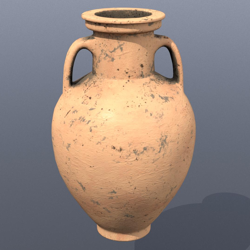
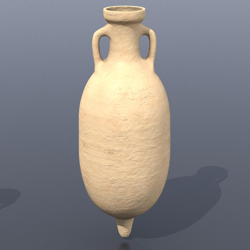
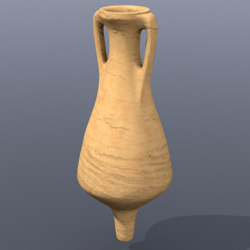
Amphora for the transport of fish sauces produced in Spain in the I-II centuries AD.

Technical Specifications

FormatLightwave 2018, OBJ, FBX, Blender 3, glTF
Compatibility3ds Max, Blender, Cinema4D, Houdini, Lightwave, Maya, Unity, Unreal Engine, Other
RiggedNo
GeometryPolygon mesh
Polygons Number6576
TexturesPBR
UV MappingYes

Historical Background

The Dressel 14 is a distinct type of Roman transport amphora that served as the primary container for exporting fish products, such as fish sauces (liquamen and muria) and salted fish chunks (salsamenta). Primarily manufactured in the Roman province of Lusitania (modern-day Portugal), it was widely circulated across the Western Mediterranean during the Early Empire, spanning from the 1st to the 3rd century AD.

Morphological Characteristics
The Dressel 14 is characterized by its long, functional design tailored for ship stowage:
• Body: Tall and cylindrical, tapering down to a pointed base or solid spike (pivolo).
• Neck & Rim: Features a high, narrow neck with a variable rim profile that ranges from triangular to semi-circular.
• Handles: Two vertical ribbon handles attached directly below the rim and resting on the upper shoulder.
• Dimensions: Typically stands between 80 to 110 cm tall with a maximum diameter of roughly 30 cm.

Origins and Production Centers
While Heinrich Dressel originally cataloged the form in 1899 based on fragments found in Rome, identifying them generally as South Spanish, modern archaeology has localized their primary origin:
• Lusitania: Major kilns have been uncovered along the estuaries of the Tagus and Sado Rivers (such as the workshops at Abúl, Setúbal, and Alcácer do Sal). In this region, it is considered a true homegrown creation (Dressel 14 da Lusitânia).
• Baetica: A smaller subset of variants was also produced along the southern coast of Spain (Baetica), specifically near Motril and Calahonda.

Main Contents
Inscriptions (tituli picti) and organic residue analysis have conclusively proved that these vessels carried marine commodities:
• Garum & Liquamen: Premium fermented Roman fish sauces.
• Muria: A salty fish brine solution.
• Salsamenta: Pieces of salted fish (such as mackerel or sardines) packed tightly into the vessel.

Distribution and Trade Importance
Dressel 14 amphorae highlight the vast economic reach of Lusitanian fish processing plants. Their presence is highly documented across military and civilian sites in Italy (Rome, Ostia, and the Vesuvian sites like Pompeii and Herculaneum), as well as along the Rhône valley in Gaul (modern France). A famous intact specimen discovered at Oplontis near Mount Vesuvius featured a titulus pictus linking its luxury fish sauce contents directly to the family of Roman Empress Poppaea Sabina.

Additional Information

The object is made of quad polygons only with unwrapped and non-overlapping UV.
Two different sets of textures are included (color, ambient occlusion, roughness, specular, normal and bump) to get the same amphora with two different materials.
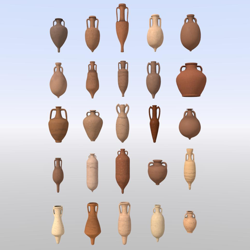
Discover more models

You may also like

View collection →