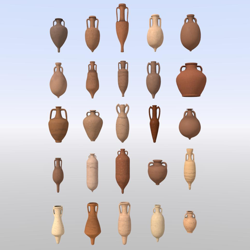
Historical Background
The Dressel 2-4 is one of the most significant and widely distributed types of Roman transport amphorae. Named after the archaeologist Heinrich Dressel—who established the fundamental typology of Roman ceramic vessels in 1879—the term actually combines three morphologically similar variants (Dressel 2, 3, and 4) into a single overarching classification.
Key Architectural Characteristics
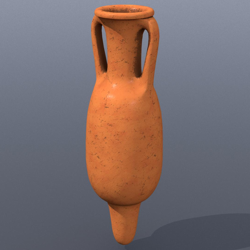
• Bifid Handles: The most distinctive feature of a Dressel 2-4 is its tall, vertical, bifid handles. Each handle is composed of two parallel clay rods joined together, forming a sharp or rounded peak at the top where it meets the neck.
• Body Shape: A tall, cylindrical body with distinct, angular (carinated) shoulders.
• Rim & Base: It features a small, simple beaded rim and tapers down at the bottom into a short, solid clay spike (or toe).
• Capacity: Generally held between 26 to 34 liters of liquid.
Origin and Evolution
The form was directly inspired by Greek prototypes from the Aegean island of Kos (hence its colloquial classification as a "Koan" type).
In the late 1st century BC, Roman potters adopted this style to replace the heavier, thick-walled Dressel 1 amphora. The Dressel 2-4 design represented a massive technological upgrade: it had significantly thinner walls, making it up to 30% lighter while maintaining a higher volume-to-weight ratio. This design efficiency allowed merchant ships to pack more product; for instance, a vessel that could carry roughly 4,500 Dressel 1 amphorae could fit close to 6,000 Dressel 2-4 vessels in the same space.
Primary Contents & Widespread Trade
• Main Cargo: The Dressel 2-4 was primarily used to transport wine across the Roman Empire. To protect the cargo, the interior walls were frequently coated with a layer of pine resin to seal the porous terracotta and flavor the wine.
• Secondary Uses: Occasionally, it was reused or packed with fish sauce (garum or defrutum), olive oil, or dates.
• Global Footprint: While initial large-scale production was concentrated in central Italy (particularly Campania and Etruria), the design was so successful that local workshops imitated it across the Roman provinces, including Spain (Tarraconensis and Baetica), Gaul (France), and Britain. Its trade distribution maps the height of the early Roman maritime economy, with shipwrecks and shards recovered everywhere from the northern frontiers of Britain to as far as India.
Chronology
The peak era of the Dressel 2-4 spans from the late 1st century BC through the end of the 1st century AD (flourishing under the Augustan and Julio-Claudian periods). Production began declining by the mid-2nd century AD as the Western Mediterranean shifted toward flat-bottomed regional amphorae styles.
Additional Information
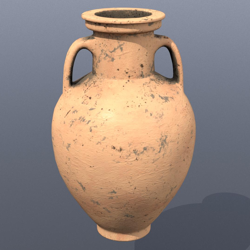
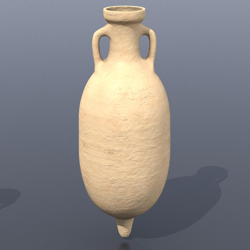
The object is made of quad polygons only with unwrapped and non-overlapping UV.
Two different sets of textures are included (color, ambient occlusion, roughness, specular, normal and bump) to get the same amphora with two different materials.