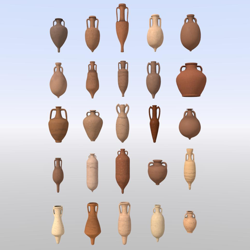
Historical Background
The Brindisi type amphora (also known as anfora brindisina or Ostia 66) was a distinct class of ancient Roman ceramic transport container produced along the southern Adriatic coast of Italy, primarily in the ager Brundisinus (the region surrounding modern-day Brindisi, Puglia). These vessels were manufactured heavily between the mid-2nd century BCE and the late 1st century BCE (Late Roman Republic to early Imperial periods), serving as a cornerstone of the regional maritime economy.
Key Characteristics & Anatomy
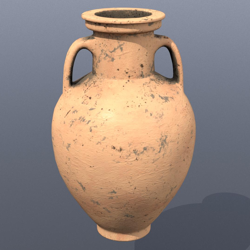
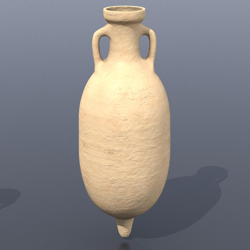
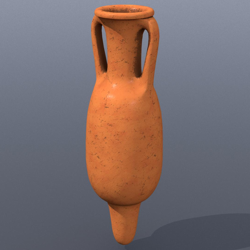
• Shape & Profile: It is categorized broadly within the ovoid/piriform family of amphoras. It features a wide, rounded shoulder that tapers downwards into an oval or pear-shaped body.
• Neck & Rim: It has a relatively short, cylindrical neck topped with a thickened, out-turned rim (often triangular or band-like in profile).
• Handles: Two thick, arched handles that are round or stick-like in cross-section (anse a bastone). They are attached vertically just below the lip and descend down to the broad shoulder.
• Base: The bottom terminates in a short, solid knobbed or button-shaped foot (puntale a bottone), designed to aid in stable stacking inside the hulls of merchant ships.
• Fabric & Clay: Typically made of fine, micaceous red-brown to pinkish clay, often covered in a dull cream or yellowish surface slip.
Function & Trade Content
These containers were primarily designed for the bulk transport of Apulian olive oil, though residue analyses and historical context suggest some variants were also utilized to ship wine.
Production Centers & Workshop Stamps
Major specialized kiln sites have been excavated in the coastal areas around Brindisi, most notably at Apani and Giancola, as well as inland at Marmorelle.
A highly valuable feature for archaeologists is that Brindisian amphoras are frequently stamped. Rectangular epigraphic stamps were impressed into the wet clay at the top of the handles before firing. Written in Latin or Greek characters, they often state the names of prominent workshop owners (officinatores) or the actual potters/slaves who shaped the vessels, providing clear evidence of early industrial Roman trade structures.
Geographical Distribution
While common in the western Mediterranean, Brindisi amphoras are exceptionally abundant in eastern Mediterranean trade routes. Massive quantities of fragments have been recovered along the coasts of Dalmatia, Greece, Asia Minor, Egypt (including Alexandria and Naukratis), and the Levant, tracking the movement of Italian merchants and military supplies during the expansion of the Roman Republic.
Additional Information
The object is made of quad polygons only with unwrapped and non-overlapping UV.
Two different sets of textures are included (color, ambient occlusion, roughness, specular, normal and bump) to get the same amphora with two different materials.