Historical Background
The Dressel 1 amphora is one of the most archaeologically significant ceramic transport vessels of the late Roman Republic, serving as the primary container for the massive Mediterranean wine trade from the mid-2nd century BC until around 10 BC. Named after archaeologist Heinrich Dressel, who categorized the Roman typologies in 1879, it represents the boom of slave-based agrarian economies in central Italy.
Key Anatomical & Structural Features
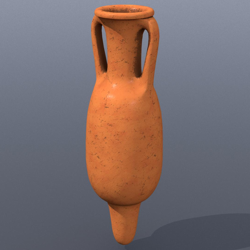
• Design: They feature a tall cylindrical body, strong angular shoulders, a long narrow neck, and a long solid spike (or peg) at the base used for upright storage in sand or ship holds.
• Handles: Heavy, long, and straight vertical loop handles flank the neck.
• Fabric: Characterized by a thick, heavy, and robust red or reddish-brown clay. The most famous Italian variants feature a distinct "black sand" fabric (containing green augite crystals) characteristic of the volcanic soils around Pompeii and Herculaneum.
• Capacity: Typically carried between 24 to 26 liters of liquid. When empty, the heavy terracotta alone weighed a massive 18 to 26 kg, giving it a relatively low volume-to-weight efficiency.
The Three Main Sub-types
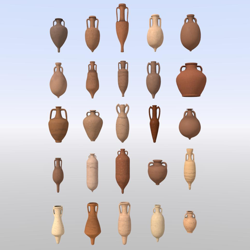
Archaeologists sub-divide the Dressel 1 into three distinct chronological and morphological variations:
Sub-type Timeline Distinctive Morphological Features
Dressel 1A: ~150 BC – 50 BC - Short, triangular profile rim and a shorter base spike.
Dressel 1B: ~70 BC – 10 BC - A tall, vertical, and heavy "collar" rim (>45mm high) with a longer, slightly flared base spike. It was built thicker and heavier to withstand long voyages.
Dressel 1C: ~130 BC – 30 BC - A more spindle-like profile featuring a very tall rectangular lip and "S"-shaped handles.
Origins, Contents, and Distribution
• Production Centers: The vast majority originated along the Tyrrhenian coast of Italy—specifically Campania, Latium (Lazio), and Etruria. However, minor local imitations have been uncovered in Gaul and the Guadalquivir Valley of Spain.
• Primary Contents: They were purpose-built to export prestigious central Italian luxury wines (such as Falernian and Caecuban). Occasionally, they were reused or filled with defrutum (reduced wine mustache), olives, or fish sauces.
• Trade Footprint: Millions of Dressel 1 vessels crossed the ancient world. They are found heavily concentrated in shipwrecks along the French coast, throughout Gaul (where tens of millions of jars were imported to supply the Celtic demand for wine), Germany, and across the English Channel into southern Britain.
The Evolutionary Successor
By the late 1st century BC, the Dressel 1 type abruptly vanished. It was completely replaced by the Dressel 2-4 type, which featured double-barreled (bifid) handles and much thinner walls. The Dressel 2-4 was roughly 30% lighter while holding the same volume, allowing Roman merchant ships to load vastly more cargo in a single voyage.
Additional Information
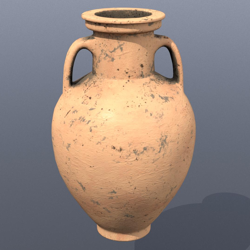
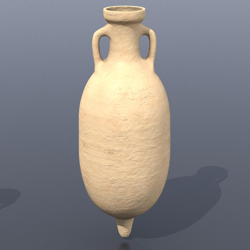
The object is made of quad polygons only with unwrapped and non-overlapping UV.
Two different sets of textures are included (color, ambient occlusion, roughness, specular, normal and bump) to get the same amphora with two different materials.