HISTORICAL 3D MODELS · DIGITAL DOWNLOADS
CARLO CESTRADIGITAL PRODUCTIONS
Home / CGI Models / Dressel-28 type Amphora
CGI / Digital 3D Model

Dressel-28 type Amphora

Choose the version and license that best fits your project.

Available versions & licenses

Choose a product version
Selected version$4.99USD
Included download files

File names only. Secure downloads become available after purchase.

License terms for selected version

Read the license conditions before purchasing. PDFs open in a new tab.

Digital products. Digital products only. Review the selected version and its license before purchase.

Description

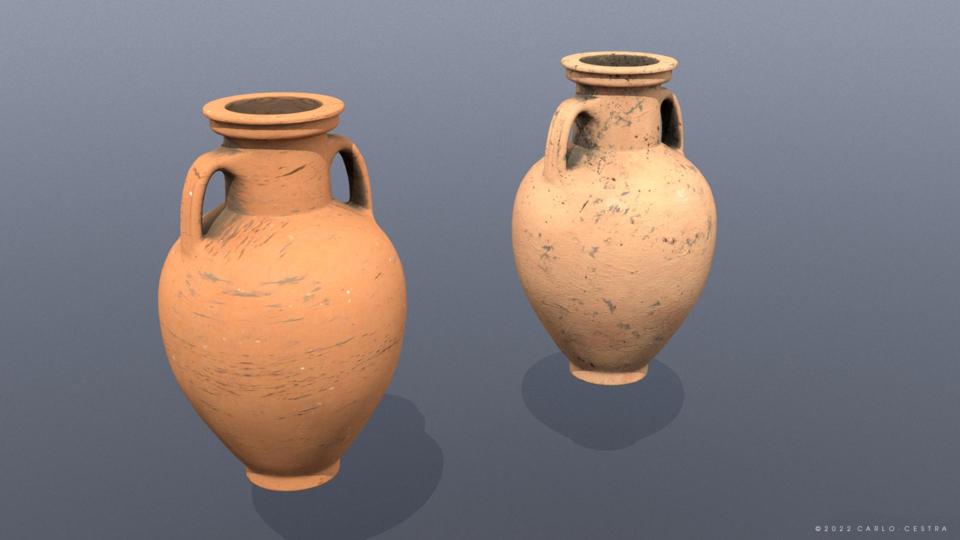
Amphora for the transport of wine and fish sauces produced in Spain in the I-II centuries AD.

Technical Specifications

FormatLightwave 2018, OBJ, FBX, Blender 3, glTF
Compatibility3ds Max, Blender, Cinema4D, Houdini, Lightwave, Maya, Unity, Unreal Engine, Other
RiggedNo
GeometryPolygon mesh
Polygons Number7524
TexturesPBR
UV MappingYes

Historical Background

The Dressel 28 amphora is a specific category of ancient Roman shipping container first cataloged by German epigraphist Heinrich Dressel in 1899. Unlike many traditional pointed-bottom Roman transport vessels, the Dressel 28 is notable for its flat-based, two-handled design, which allowed it to stand upright more easily.

Key Characteristics & Design
• Shape and Rim: It features a distinct globular or ovoid body, a molded cylindrical neck, two short rounded handles, and a collared rim with a prominent groove on its outer face (often resembling a pulley wheel).
• Size: They generally measure between 40 to 55 centimeters in height. Because of their relatively small size, fragmented handles or bases can easily be confused with common ancient household jars.
• Evolution: According to chronological frameworks established by archaeologists, earlier pre-Flavian variations had uniform upper and lower rim moldings with thinner walls, while later Flavian-era versions developed a more prominent lower molding.

Origins & Production
The Dressel 28 was manufactured predominantly in southern Spain (Hispania Baetica and Tarraconensis). However, workshop evidence shows that local production also extended to southern Gaul (modern-day France).

Contents & Trade
These vessels were utilized primarily during the 1st and 2nd centuries AD to distribute commodities across the Western Mediterranean and northwestern Roman provinces. Archaeological findings suggest they were multi-purpose containers, primarily carrying wine, fish sauces (such as garum), and occasionally olive oil.

Additional Information

The object is made of quad polygons only with unwrapped and non-overlapping UV.
Two different sets of textures are included (color, ambient occlusion, roughness, specular, normal and bump) to get the same amphora with two different materials.
Discover more models

You may also like

View collection →