Home / Modelli CGI / Dressel-38 type Amphora
Avviso sulla risoluzione delle texture: I render della galleria potrebbero essere stati realizzati con texture a risoluzione superiore rispetto alla versione scelta. Le texture a risoluzione inferiore potrebbero mostrare meno dettagli. Controlla le specifiche della variante selezionata.
CGI / Modello 3D digitale
Dressel-38 type Amphora
Scegli la versione e la licenza più adatte al tuo progetto.
Versioni e licenze disponibili
Versione selezionata$4.99USD
File ZIP inclusi
I download protetti saranno disponibili dopo l’acquisto.
Download gratuito
Non servono registrazione, dati di fatturazione o PayPal. Ogni file si scarica separatamente.
Condizioni della licenza selezionata
Leggi le condizioni di licenza prima di acquistare. I PDF si aprono in una nuova scheda.
Prodotti digitali. Solo prodotti digitali. Controlla la versione selezionata e la relativa licenza prima dell’acquisto.
Descrizione
Amphora for the transport of fish sauces produced in Spain in the I-II centuries AD.
Specifiche tecniche
| Formato | Lightwave 2018, OBJ, FBX, Blender 3, glTF |
|---|---|
| Animato / Rigged | No |
| Geometria | Polygon mesh |
| Numero di poligoni | 6960 |
| Texture | PBR |
| Mappatura UV | Yes |
Contesto storico
The Dressel 38 amphora is a specific class of ancient Roman pottery vessel categorized under Heinrich Dressel’s pioneering 1899 typology chart. It was widely utilized during the peak of maritime trade in the Roman Empire.
Core Overview
• Primary Function: The Dressel 38 was explicitly manufactured for the transport of fish sauces (such as garum, liquamen, or muria) and salted fish preserves.
• Origin & Production: These vessels were primarily produced in the Roman province of Baetica (modern-day southern Spain), along the coastal areas where massive marine salting factories (cetariae) operated.
• Chronological Range: They were in active use from the 1st century AD to the end of the 2nd century AD.
• Alternate Classifications: In alternative regional archaeological catalogs, this specific profile is frequently cross-referenced as Beltrán IIA.
Physical Design Characteristics
• Shape: It features a wide, funnel-shaped mouth and neck, which facilitated the pouring of thick, dense liquids like fish sauce. The body is typically ovoid, transitioning into a pointed base or solid "toe" at the bottom designed to lock neatly into stackable wooden racks in a ship's hold.
• Dimensions: A standard specimen ranges between 90 to 100 cm in height and approximately 30 to 35 cm in width.
• Handles: It is built with two robust, straight vertical handles anchoring the neck to the upper shoulder to bear the heavy load of fluid transport.
Trade & Distribution
Dressel 38 amphoras have been recovered heavily across Mediterranean shipwrecks and archaeological excavation layers stretching from the western provinces (like Gaul and Britain) to military and frontier outposts. Their presence serves as a key economic indicator of the widespread distribution networks of Roman Spanish culinary products.
Informazioni aggiuntive
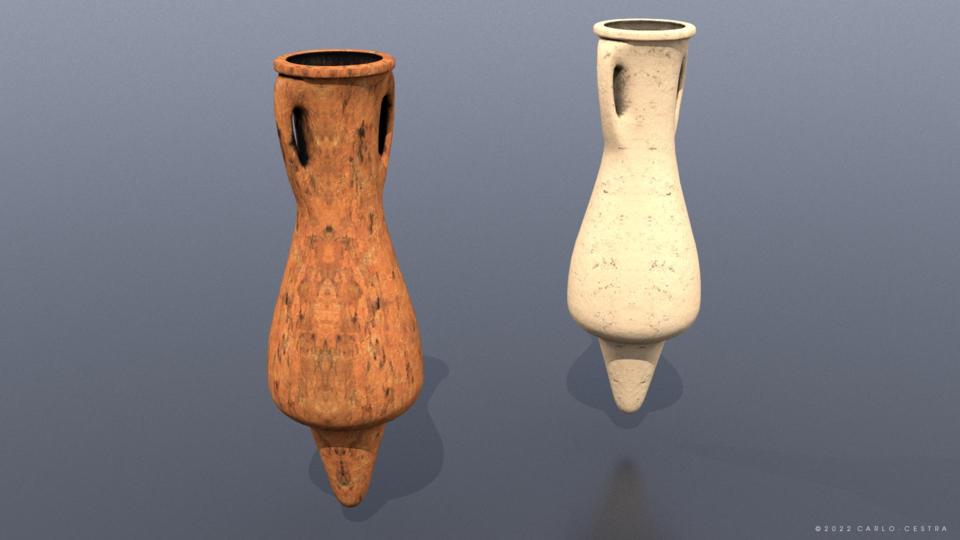
The object is made of quad polygons only with unwrapped and non-overlapping UV.
Two different sets of textures are included (color, ambient occlusion, roughness, specular, normal and bump) to get the same amphora with two different materials.
Scopri altri modelli