HISTORICAL 3D MODELS · DIGITAL DOWNLOADS
CARLO CESTRADIGITAL PRODUCTIONS
Home / CGI Models / Pascual-1 type Amphora
CGI / Digital 3D Model

Pascual-1 type Amphora

Choose the version and license that best fits your project.

Available versions & licenses

Choose a product version
Selected version$4.99USD
Included download files

File names only. Secure downloads become available after purchase.

License terms for selected version

Read the license conditions before purchasing. PDFs open in a new tab.

Digital products. Digital products only. Review the selected version and its license before purchase.

Description

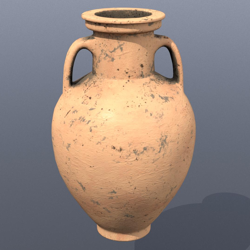
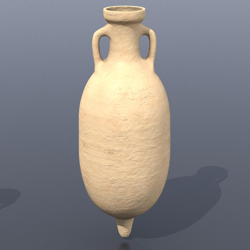
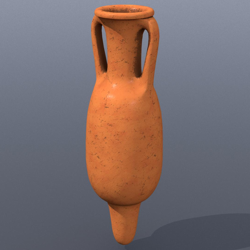
Amphora for the transport of wine produced in Spain between I century BC and I century AD.

Technical Specifications

FormatLightwave 2018, OBJ, FBX, Blender 3, glTF
Compatibility3ds Max, Blender, Cinema4D, Houdini, Lightwave, Maya, Unity, Unreal Engine, Other
RiggedNo
GeometryPolygon mesh
Polygons Number6800
TexturesPBR
UV MappingYes

Historical Background

The Pascual 1 is a distinct type of Roman transport amphora produced primarily in Hispania Tarraconensis (modern-day Catalonia, northeast Spain). Used extensively from approximately 40 BC to AD 20–30, it was the most dominant vessel type for exporting local surplus wine from the region to the western Roman provinces during the Augustan era.

Key Characteristics & Mechanics
• Design & Origin: The shape is closely modeled as an imitation of the Italian Dressel 1B amphora. It features a characteristic tall, vertical collared rim, a cylindrical neck, an ovoid body, and rounded handles with a narrow groove on the outer face.
• Contents: It primarily transported regional Catalan wines, including premium varieties like Aminnean wine, holding an average volume of around 25 liters.
• Fabrics: Found predominantly in two variations: a hard, rough dark red to reddish-brown fabric (common to Catalan production) and a softer, pale cream/creamy-white fabric.
• Distribution: Its primary maritime trade routes went along the Catalan and southern French coasts into Gallia Narbonensis. From there, it spread heavily along the Aude-Garonne river axis toward the Atlantic, reaching as far as Britain and Germania.

Additional Information

The object is made of quad polygons only with unwrapped and non-overlapping UV.
Two different sets of textures are included (color, ambient occlusion, roughness, specular, normal and bump) to get the same amphora with two different materials.
Discover more models

You may also like

View collection →