Historical Background
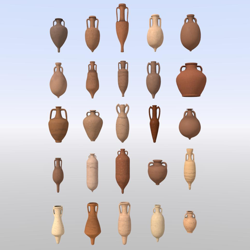
The Dressel 7–11 represents a prominent class of ancient Roman shipping containers primarily manufactured in Hispania Baetica (modern-day Andalusia, Spain) and parts of Hispania Tarraconensis. Dating heavily from the late 1st century BC to the early 2nd century AD, this typological family was the primary vessel choice for transporting highly valued Roman fish products, notably garum (fermented fish sauce), liquamen, and salazon (salted fish preserves).
Morphology and Characteristics
First cataloged by archaeologist Heinrich Dressel in his seminal late-19th-century typology, the Dressel 7–11 series includes closely related regional variations (such as Dressel 7, 8, 9, 10, and 11) sharing distinct stylistic parameters:
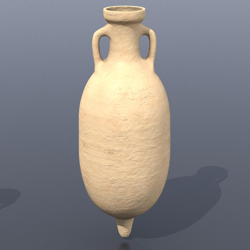
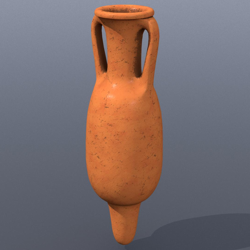
• Body Shape: A prominent ovoid or near-cylindrical body tapering down into a long, hollow spike or pivot at the base. The hollow pivot was functional, acting as a third handle during tilting and helping lock the vessels upright into sand or wooden racks aboard cargo ships.
• Neck and Rim: A tall, wide cylindrical neck featuring a distinctly flared or "out-turned" rim styled like an open corolla.
• Handles: Two long, heavy vertical handles with flattened oval cross-sections. They are attached just below the lip and form a sharp, tight bend back down to the top of the body.
• Fabric Composition: Typically molded from a soft, powdery, pale-colored clay matrix ranging from cream and off-white to yellowish-pink tones, often carrying a light wash or slip finish.
Trade and Distribution
Because they supplied the massive Roman demand for luxury seafood sauces, Dressel 7–11 amphoras have been discovered in huge quantities along maritime trade routes. While originating heavily in southern Spain's bustling coastal salting factories, they are regular components of shipwrecks and urban excavations scattered all over the Western Mediterranean, Italy, Gaul, Germania, and the northwest imperial frontiers like Roman Britain.
Additional Information
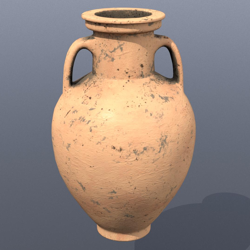
The object is made of quad polygons only with unwrapped and non-overlapping UV.
Two different sets of textures are included (color, ambient occlusion, roughness, specular, normal and bump) to get the same amphora with two different materials.