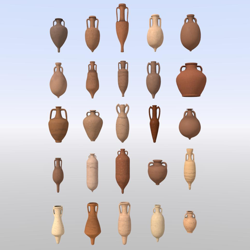
Historical Background
The Dressel 20 is a distinct type of large, globular Roman amphora primarily used to transport olive oil across the Roman Empire. Originally produced in the Guadalquivir Valley within the Roman province of Baetica (modern-day Andalusia, Spain), it stands as one of the most widely distributed and archeologically significant ceramic transport containers of antiquity.
Key Characteristics & Specifications
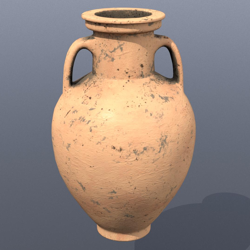
• Shape & Anatomy: They feature a spherical/globular body with thick ceramic walls, a short cylindrical neck, a thick beaded or triangular rim, and two heavy, curved cylindrical handles. The base terminates in a small conical or button-shaped pivot.
• Fabric & Composition: Made of coarse, sandy, granular clay. The fabric color ranges from buff/cream to light orange or red, heavily included with quartz, limestone, and feldspar.
• Capacity & Size: They typically carried an average of 60 to 65 liters of olive oil, with an overall functional range spanning between 40 and 80 liters. A complete vessel measures roughly 55–70 cm in height.
• Chronology: Production of the definitive Dressel 20 form began during the reign of Tiberius or Claudius (c. 30–40 AD), evolving from precursors like the Oberaden 83 and Haltern 71. Mass production peaked during the Antonine period and finally ceased around 260 AD, when it was succeeded by the Dressel 23 variant.
Mass Production & Epigraphy
The Dressel 20 is famous for the intricate commercial tracking systems stamped and painted onto its surface. Because Baetican olive oil was produced at an industrial scale to supply Rome and its faraway military frontiers, workshops utilized distinct legal and logistical marks:
• Stamps: Potters or estate owners stamped the handles before firing to mark production provenance (e.g., stamps like ACIRGI or ROMANI).
• Tituli Picti: Inscriptions painted in dark pigments onto the neck or shoulders of the vessel. These detailed commercial notes recorded the weight of the empty jar, the weight of the oil, the merchant's name, and official customs control stamps.
Distribution & Archaeological Impact
Due to their porous composition, Dressel 20 amphoras were single-use export containers. Once they reached their destination and were drained, they were smashed and discarded.
Millions of these broken fragments were dumped systematically in Rome, entirely forming Monte Testaccio—an artificial hill constructed almost exclusively from millions of discarded Baetican oil amphoras. They are also recovered in immense quantities along the Rhine and Danube military frontiers (limes) and throughout Roman Britain, charting the expansive scope of the Roman global economy.
Additional Information
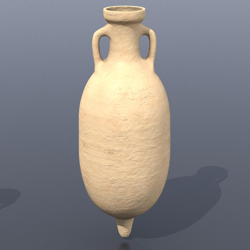
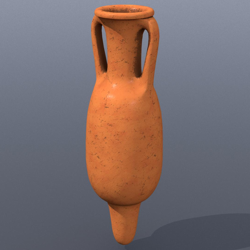
The object is made of quad polygons only with unwrapped and non-overlapping UV.
Two different sets of textures are included (color, ambient occlusion, roughness, specular, normal and bump) to get the same amphora with two different materials.