HISTORICAL 3D MODELS · DIGITAL DOWNLOADS
CARLO CESTRADIGITAL PRODUCTIONS
Home / CGI Models / Vinaria type Amphora
CGI / Digital 3D Model

Vinaria type Amphora

Choose the version and license that best fits your project.

Available versions & licenses

Choose a product version
Selected version$4.99USD
Included download files

File names only. Secure downloads become available after purchase.

License terms for selected version

Read the license conditions before purchasing. PDFs open in a new tab.

Digital products. Digital products only. Review the selected version and its license before purchase.

Description

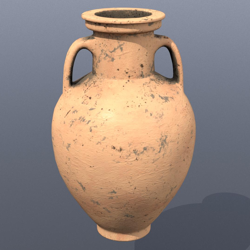
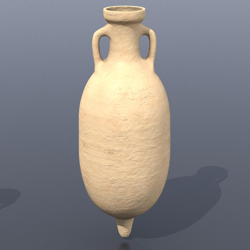
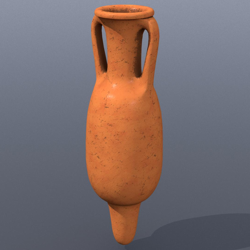
Amphora for the transport of wine produced in the central northern Italy in the I-III centuries AD.

Technical Specifications

FormatLightwave 2018, OBJ, FBX, Blender 3, glTF
Compatibility3ds Max, Blender, Cinema4D, Houdini, Lightwave, Maya, Unity, Unreal Engine, Other
RiggedNo
GeometryPolygon mesh
Polygons Number9028
TexturesPBR
UV MappingYes

Historical Background

An amphora vinaria (plural: amphorae vinariae) refers to a specific class of ancient ceramic vessel designed by the Phoenicians, Greeks, and Romans exclusively for the transport, storage, and aging of wine.
In modern digital modeling and historical typologies, the "Vinaria type" represents the standardized, elongated terracotta jars mass-produced along the Italic coast and Gaul between the 2nd century BCE and 3rd century CE.

Historical Roman Typologies
In classical archaeology, ancient wine amphorae are classified using precise typologies established by researchers like Heinrich Dressel:
• Dressel 1 (A, B, C): The quintessential Roman Republican wine amphora (2nd to 1st century BCE). Characterized by a thick, heavy body, an inverted cone neck, and straight handles. It was used to ship famous regional vintages like Caecuban and Falernian across the Roman Empire.
• Dressel 2-4: A lighter, double-handled evolution modeled after Greek Koan vessels. They offered a 30% better volume-to-weight ratio and dominated western Mediterranean maritime trade until the late 1st century CE.
• Gauloise 2: A flat-bottomed regional type produced primarily in Roman Gaul for distributing local provincial wines.

Anatomy and Practical Features
• The Spiked Base (Peduncle): Instead of a flat bottom, these vessels ended in a sharp point. This serves three purposes: acting as a third handle during tilting, allowing them to be tightly packed upright into the sandy beds of cargo ships, and allowing the heavy sediment (lees) to settle compactly at the narrow bottom.
• Standard Capacity: A typical Roman wine amphora held roughly 26 liters (equivalent to one ancient Roman cubic foot, or an amphora quadrantal).
• Sealing Methods: To protect the contents from spoiling over long sea journeys, the interiors were lined with pine pitch or beeswax. They were sealed tightly using cork, wood, or clay stoppers.

Additional Information

The object is made of quad polygons only with unwrapped and non-overlapping UV.
Two different sets of textures are included (color, ambient occlusion, roughness, specular, normal and bump) to get the same amphora with two different materials.
Discover more models

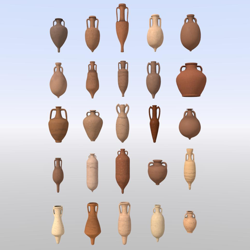
You may also like

View collection →