HISTORICAL 3D MODELS · DIGITAL DOWNLOADS
CARLO CESTRADIGITAL PRODUCTIONS
Home / CGI Models / QF 2-pounder Mark VIII 4-barelled
CGI / Digital 3D Model

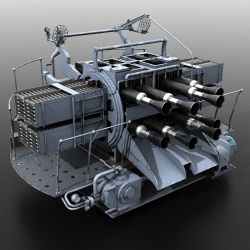
QF 2-pounder Mark VIII 4-barelled

Choose the version and license that best fits your project.

Available versions & licenses

Choose a product version
Selected version$69.00USD
Included download files

File names only. Secure downloads become available after purchase.

License terms for selected version

Read the license conditions before purchasing. PDFs open in a new tab.

Digital products. Digital products only. Review the selected version and its license before purchase.

Description

The QF 2-pounder Mark VIII 4-barrelled mounting (officially designated the Mark VII mounting) was a highly recognizable British 40 mm light anti-aircraft autocannon used extensively by the Royal Navy during World War II.

Technical Specifications

FormatLightwave 2018, OBJ, FBX, Blender 2.79
Compatibility3ds Max, Blender, Cinema4D, Houdini, Lightwave, Maya, Unity, Unreal Engine, Other
RiggedLightwave
GeometryPolygon mesh
Polygons Number175k
TexturesPBR
UV MappingYes

Historical Background

While a larger 8-barrelled mounting (Mark V and VI) protected heavy warships like battleships and aircraft carriers, the 4-barrelled Mark VII mounting entered service in 1935. It was specifically designed to provide dense, close-range air defense for smaller combatants, such as cruisers and destroyers.

Key Technical Specifications
The weapon system balanced sustained firepower with complex, linked ammunition handling:
Caliber: 40 mm (1.575 in)
Rate of Fire: 96–115 rounds per minute per barrel (up to 460 RPM total for the mount)
Muzzle Velocity: 2,400 ft/s (732 m/s) with High-Velocity (HV) ammunition
Effective Ceiling: ~13,300 feet (3,960 meters)
Ammunition Feed: 14-round steel link belts
Mount Capacity: 448 rounds ready-use (112 rounds per gun)

Key Features & Operational Design
• Arrangement: The quadruple mount arranged the four barrels into two rows of two. To ensure a compact layout, the guns were manufactured in custom variations (left-hand, right-hand, inner, and outer) so their feed systems and ejector mechanisms aligned perfectly without jamming into one another.
• High-Velocity (HV) Upgrade: In 1938, the Royal Navy introduced High-Velocity ammunition to counter faster modern aircraft. This increased the effective range from a short 1,200 yards to a much safer 1,700 yards.
• Fire Control Evolution: Early versions relied on manual tracking, which struggled against fast targets. By 1941, the system was significantly enhanced by marrying the guns to the Mark V Fire Control Director, utilizing an analog computer and Type 282 radar to automatically direct the mount toward invisible or night-flying targets.
Though later partially supplanted by the harder-hitting 40mm Bofors gun against high-speed torpedo planes, the 4-barrelled pom-pom remained an invaluable and reliable weapon for defending Allied convoys against low-altitude threats and kamikaze strikes throughout the war.

Additional Information

The model was created based on blueprints, photos and historical documentation. It was created with precision in detail and in real units of measurement to be a faithful digital reproduction of the original. The object has been modeled in Lightwave and finished and texturized in 3DCoat.
LIGHTWAVE 2018 - The model comes with a simple Lightwave 2018 setup scene to animate pitch and heading rotation.
OBJ and FBX - model with UV maps. You may need to reassign textures when open the files with different software.
BLENDER 2.79 - UV model with uv material assigned
The object has three UV map with color, normal, roughness, metalness and specular textures
Discover more models

You may also like

View collection →