HISTORICAL 3D MODELS · DIGITAL DOWNLOADS
CARLO CESTRADIGITAL PRODUCTIONS
Home / CGI Models / QF 2-pounder Mark VIII Chicago piano
CGI / Digital 3D Model

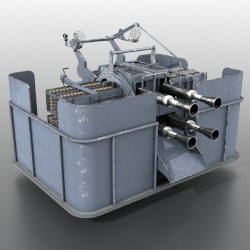
QF 2-pounder Mark VIII Chicago piano

Choose the version and license that best fits your project.

Available versions & licenses

Choose a product version
Selected version$69.00USD
Included download files

File names only. Secure downloads become available after purchase.

License terms for selected version

Read the license conditions before purchasing. PDFs open in a new tab.

Digital products. Digital products only. Review the selected version and its license before purchase.

Description

The QF 2-pounder Mark VIII was a famous 40 mm British automatic anti-aircraft autocannon extensively used by the Royal Navy and Allied forces during World War II. Universally nicknamed the "pom-pom" due to the distinctive rhythmic sound of its rhythmic firing, its heavy multi-barrel variations (specifically the quadruple and octuple mounts) earned the terrifying moniker "Chicago Piano".

Technical Specifications

FormatLightwave 2018, OBJ, FBX, Blender 2.79
Compatibility3ds Max, Blender, Cinema4D, Houdini, Lightwave, Maya, Unity, Unreal Engine, Other
RiggedLightwave
GeometryPolygon mesh
Polygons Number215k
TexturesPBR
UV MappingYes

Historical Background

The "Chicago Piano" name was a playful nod to the massive size of the multi-barrel installations paired with the rapid fire rate, drawing a direct parallel to the infamous Thompson submachine gun ("Chicago Typewriter") used by era gangsters.

The Multi-Barrel Configurations
To establish an effective close-range wall of fire against incoming torpedo bombers and dive bombers, the British design integrated multiple Mark VIII guns into massive, complex mounts:
• Octuple Mounts (Mark V & Mark VI): These massive installations weighed between 11.8 and 17.35 tons and featured eight barrels arranged in two rows of four. They were typically reserved for capital ships like battleships (such as the HMS Rodney), cruisers, and aircraft carriers.
• Quadruple Mounts (Mark VII): Introduced starting in 1935, these configurations functioned as half of an octuple mount (four barrels arranged in two rows of two) and were lightweight enough to arm smaller warships like destroyers.
Because of how tightly packed the guns were in these "pianos," the weapons had to be meticulously manufactured in matching pairs—including left-hand, right-hand, inner, and outer feed mechanisms—so that the ammunition belt loading and empty shell casings would eject smoothly without jamming.

Technical Specifications (Mark VIII High Velocity)
The core ballistic attributes of the weapon system include:
Caliber: 40 mm (1.6 inches)
Ammunition: 40×158mmR shell (1.8 lb High Velocity)
Cyclic Rate of Fire: 115 rounds per minute per barrel (practically reduced to ~97 rpm in action)
Muzzle Velocity: 732 meters per second (2,400 ft/s)
Effective Ceiling: 3,960 meters (approx. 13,000 feet)
Magazine Capacity: 140 belted rounds per gun (for the octuple mount)

Combat Performance & Legacy
The Mark VIII was the standard mid-range shield of the British and Commonwealth fleets throughout WWII. While it proved highly effective at throwing up dense blankets of lead to deter low-altitude kamikaze attacks, it began to struggle later in the war against faster, modernized aircraft.
The shorter 40x158mmR cartridge lacked the raw velocity and stopping power of its primary wartime contemporary, the Swedish-designed 40 mm Bofors gun, which eventually became the preferred choice for long-range anti-aircraft protection. However, due to severe industrial shortages early in the war, the "Chicago Piano" remained an indispensable workhorse that defended Allied shipping lines across every major theater of naval operations.

Additional Information

The model was created based on blueprints, photos and historical documentation. It was created with precision in detail and in real units of measurement to be a faithful digital reproduction of the original. The object has been modeled in Lightwave and finished and texturized in 3DCoat.
LIGHTWAVE - The model comes with a simple Lightwave 2018 setup scene to animate pitch and heading rotation.
OBJ and FBX - model with UV maps. You may need to reassign textures when open the files with different software.
BLENDER - UV model with uv material assigned
The object has three UV maps, each one with color, normal, roughness and specular textures
Discover more models

You may also like

View collection →