HISTORICAL 3D MODELS · DIGITAL DOWNLOADS
CARLO CESTRADIGITAL PRODUCTIONS
Home / CGI Models / BATTLESHIP YAMATO-TEN-ICHIGO
CGI / Digital 3D Model

BATTLESHIP YAMATO-TEN-ICHIGO

Choose the version and license that best fits your project.

Available versions & licenses

Choose a product version
Selected version$449.00USD
Included download files

File names only. Secure downloads become available after purchase.

License terms for selected version

Read the license conditions before purchasing. PDFs open in a new tab.

Digital products. Digital products only. Review the selected version and its license before purchase.

Description

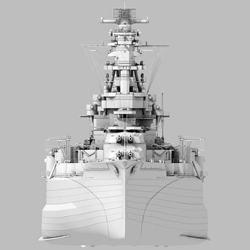
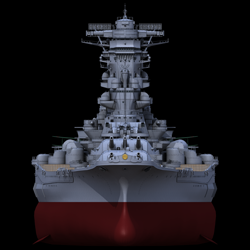
Yamato battleship was the lead ship of the Yamato class of Imperial Japanese Navy during the Second World War.
Operation Ten-Ichi-Go (Operation Heaven Number One) was the final, desperate suicide mission of the Japanese super-battleship Yamato, launched on April 6–7, 1945, during the closing months of World War II.

Technical Specifications

FormatLightwave 2015 or higher
CompatibilityLightwave
RiggedYes
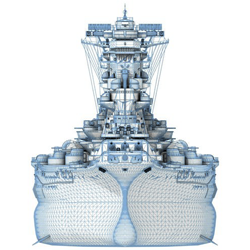
GeometryPolygon mesh
Polygons Number3.55 milions
TexturesYes (basic texture maps)
UV Mappingflags and grids ONLY

Historical Background

Designed as a deliberate kamikaze raid against overwhelming American forces invading Okinawa, the mission resulted in the spectacular destruction of the largest battleship ever built and marked the effective end of the Imperial Japanese Navy.

• The Plan: The Yamato, accompanied by the light cruiser Yahagi and eight destroyers, was ordered to sail from Japan to Okinawa with only enough fuel for a one-way trip.
• The Goal: The fleet was meant to fight its way through Allied naval lines, beach itself on the Okinawan shore, and act as an unsinkable gun battery to halt the American ground invasion. Once the ship was destroyed, the surviving crew were ordered to fight to the death alongside land forces.
• The Opposition: Vice Admiral Seiichi Ito strongly opposed the plan, viewing it as a futile waste of precious fuel and human lives, but relented after being informed that Emperor Hirohito expected a final maximum effort from the Navy.

The Battle: April 7, 1945
The Japanese task force never made it to Okinawa. On the morning of April 7, US scout planes intercepted the fleet southwest of Kyushu.
The US Navy deployed Task Force 58, launching waves totaling roughly 386 to 400 carrier aircraft—including dive-bombers and torpedo planes—to overwhelm the isolated fleet.

The Demise of the Yamato
Despite the Yamato firing its massive 18-inch guns and over 150 anti-aircraft weapons, the ship had critical design vulnerabilities, including a lack of voids to absorb modern torpedo blasts. Furthermore, the US fleet intentionally targeted the ship's port side to induce capsizing.
After being struck by at least 11 torpedoes and 6 to 8 bombs, the listing super-battleship lost all power and damage control capabilities. At 14:23, as the ship capsized, the forward ammunition magazines detonated in a cataclysmic explosion. The resulting blast created a 20,000-foot mushroom cloud that could be seen from the Japanese mainland. Out of more than 3,000 crew members aboard the Yamato, fewer than 300 survived.

Additional Information

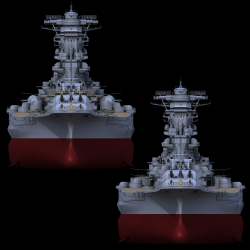
Color schemes included: YAMATO year 1945
The model was created based on blueprints, photos and historical documentation. It was created with precision in detail and in real units of measurement to be a faithful digital reproduction of the original. Modeling, texturing and setup are all made with Lightwave 2015. Scene and model are compatible starting from Lightwave 11.x.

LIGHTWAVE FORMAT AVAILABLE ONLY

Inside the Lightwave scene there is a basic setup with controls that allows you to animate each element of the ship.
You can animate:
1) the rotation, the elevation and the recoil of each gun and armored turret;
2) the rotation of each gun and light tower control;
3) the rotation of each rangefinder;
4) the rotation of each search light;
5) the rotation of propellers and rudders.
Only flags and grids have UV maps. Other materials have planar or cubic texture maps.
Some basic textures are included. No UV texturing (except flags and grids)
Discover more models

You may also like

View collection →