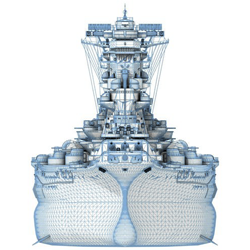
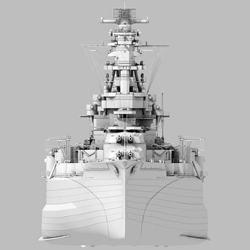
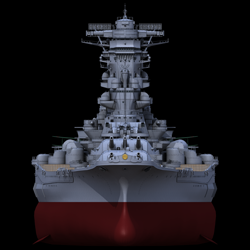
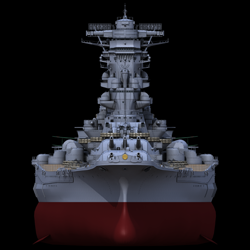
Description
Battleship Musashi was the second ship of the Yamato class of Imperial Japanese Navy during the Second World War. She and her sister, Yamato, were the heaviest and most powerful battleships ever constructed.
Historical Background
The Japanese battleship Musashi was the second of the legendary Yamato-class super-battleships built for the Imperial Japanese Navy (IJN). Alongside her sister ship, Yamato, she was the heaviest and most powerfully armed battleship ever constructed in naval history. Designed under extreme secrecy, Musashi was intended to defeat multiple enemy warships simultaneously by outclassing them in sheer firepower and armor thickness.
Key Technical Specifications
Displacement: ~72,000–73,000 long tons fully loaded.
Dimensions: 263 meters (862 feet) long with a beam of 38.9 meters.
Main Armament: Nine 460 mm (18.1-inch) Type 94 guns housed in three triple turrets. These remain the largest naval guns ever deployed at sea, capable of firing 1.5-ton armor-piercing shells over 40 kilometers (25 miles).
Armor: A massive steel armor belt up to 410 mm (16.1 inches) thick and turret faces protected by up to 650 mm of armor.
Propulsion: 150,000 shaft horsepower driving the ship to a top speed of 27.5 knots.
Commissioned in August 1942, Musashi served as the flagship of the IJN Combined Fleet under Admiral Isoroku Yamamoto and later Admiral Mineichi Koga.
Despite her unmatched defensive engineering—which included 1,165 watertight compartments—she succumbed to overwhelming American carrier-based air power during the Battle of Leyte Gulf. On October 24, 1944, while sailing through the Sibuyan Sea, Musashi was swarmed by successive waves of U.S. Navy aircraft. She endured an astonishing amount of punishment, taking an estimated 19 torpedo hits and 17 bomb hits. After hours of relentless attacks and progressive flooding, the colossal warship capsized and sank, carrying 1,023 of her 2,399 crew members down with her.
After remaining hidden for over 70 years, the wreck of Musashi was discovered in March 2015 by a methodical exploration team led by Microsoft co-founder Paul Allen. The fragmented remains sit roughly 900 meters (3,000 feet) deep on the floor of the Sibuyan Sea, with its bow upright, the stern completely inverted, and its massive superstructure scattered across the seabed. Under international agreements, the site is designated as a protected underwater war grave.
Additional Information
The model was created based on blueprints, photos and historical documentation. It was created with precision in detail and in real units of measurement to be a faithful digital reproduction of the original. Modeling, texturing and setup are all made with Lightwave 2015. Scene and model are compatible starting from Lightwave 11.x.
LIGHTWAVE FORMAT AVAILABLE ONLY
Inside the Lightwave scene there is a basic setup with controls that allows you to animate each element of the ship.
You can animate:
1) the rotation, the elevation and the recoil of each gun and armored turret;
2) the rotation of each gun and light tower control;
3) the rotation of each rangefinder;
4) the rotation of each search light;
5) the rotation of propellers and rudders.
Only flags and grids have UV maps. Other materials have planar or cubic texture maps.
Some basic textures are included. No UV texturing (except flags and grids)