Historical Background
By 1945, the Type 96 25 mm anti-aircraft gun (九六式二十五粍高角機銃) was the absolute backbone of the Imperial Japanese Navy's (IJN) close-in air defense. However, by the final year of World War II, it had reached the absolute limit of its operational utility and was widely considered completely ineffective against modern, heavily armored, fast-moving U.S. carrier aircraft.
The 1945 Tactical Crisis
As the Allied air threat escalated, the Japanese responded by packing as many Type 96 guns as physically possible onto their surviving warships. For instance, during its final sortie in April 1945 (Operation Ten-Go), the battleship Yamato bristled with an astonishing 150+ to 162 Type 96 mounts in triple and single configurations. Despite this immense density of fire, the guns failed to prevent the ship's destruction, serving as a stark indictment of Japan's light anti-aircraft technology.
Why the Weapon Failed in 1945
• Severe Ammunition Stoppages: Unlike Allied weapons like the Bofors 40mm which used continuous clip-feeding, the Type 96 relied on small 15-round box magazines. This forced crews to constantly halt firing to swap magazines. While its theoretical cyclic rate was 200–260 rounds per minute (rpm), the frequent reloads dropped its practical, effective rate of fire to just 110–120 rpm.
• Inadequate Range and Payload: By 1945, the 25 mm projectiles were simply too light and short-ranged to deal with planes like the F6F Hellcat or F4U Corsair. Fire beyond 2,000 meters was entirely useless. Due to critical ammunition shortages late in the war, crews were ordered to hold fire until targets were within 800 to 1,000 meters. At that point, incoming U.S. fighter-bombers had already released their payloads.
• Sluggish Tracking: The twin and triple mounts suffered from slow manual elevation and traverse speeds, making it incredibly difficult for gunners to track high-speed strafing runs or dive bombers.
• Lack of Intermediate Calibers: Unlike the Allies, who utilized a layered defense consisting of 5-inch dual-purpose guns, intermediate Bofors 40mm guns, and close-in Oerlikon 20mm cannons, Japan entirely lacked an intermediate caliber weapon. The Type 96 had to carry the burden alone.
Core Technical Specifications
Origin / Design: Derived from the 1935 French Hotchkiss design
Total Units Built: Approx. 33,000 units over the course of the war
1945 Production Rate: ~2,100 singles and ~200 dual/triple mounts monthly
Shell Size: 25×163mm
Effective Range: ~1,000 to 3,000 meters max effective
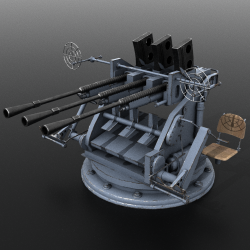
Mount Configurations: Single (785 kg), Twin (1,100 kg), Triple (1,800 kg)
Crew Complement: 3 to 9 men depending on the number of barrels
By 1945, roughly 2,500 Type 96 guns were also pulled from ships or production lines and deployed in stationary land emplacements on Pacific islands or around the Japanese mainland. On land, they were utilized in dual-purpose roles to provide anti-aircraft fire and act as direct-fire anti-tank weapons against Allied armor.
Additional Information
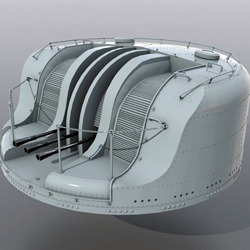
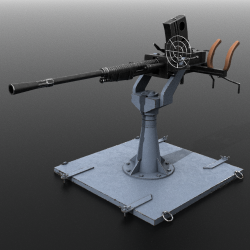
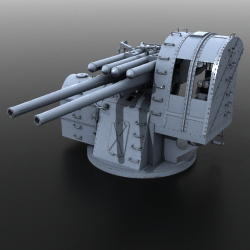
The model was created based on blueprints, photos and historical documentation. It was created with precision in detail and in real units of measurement to be a faithful digital reproduction of the original. The object has been modeled in Lightwave and finished and texturized in 3DCoat.
Some geometry (e.g. the chains segments) needs to be subdivided for close views.
Rivets are separated into a layer to use for different level of detail. The objects has 46214 polygons in total and 19034 polygons without rivets layer.
The object has one UV map with color, normal, roughness, metalness and specular textures