Historical Background
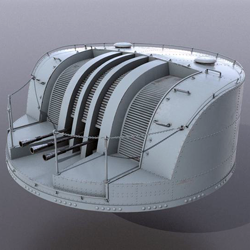
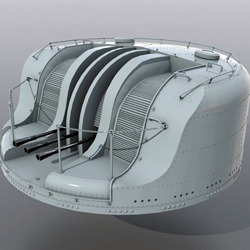
The 12.7 cm/40 Type 89 naval gun was the standard heavy anti-aircraft and dual-purpose weapon utilized by the Imperial Japanese Navy (IJN) throughout World War II. Adopted on February 6, 1932, it served as the backbone of shipboard air defense, replacing older weapons like the 8 cm/40 3rd Year Type and 12 cm/45 10th Year Type. Roughly 1,300 to 1,500 units were manufactured by the end of the war, appearing on nearly all major Japanese capital ships, carriers, cruisers, and destroyers, as well as in land-based coastal batteries.
Key Specifications
• Caliber: 12.7 cm (5 inches) / 40 calibre
• Mass: 3,100 kg (approx. 3.05 tons) per gun barrel
• Rate of Fire: 8–14 rounds per minute (highly dependent on crew proficiency)
• Muzzle Velocity: 720–725 m/s (2,360–2,379 fps)
• Maximum Horizontal Range: 14,800 meters at 45° elevation
• Maximum Anti-Aircraft Ceiling: 9,440 meters (approx. 30,840 feet) at 75° elevation
• Ammunition: Fixed 127 × 580 mm cartridges firing high-explosive (Common Type 0), incendiary shrapnel (Type 3), illumination, or anti-submarine rounds weighing 20.9 to 23.45 kg.
Design Features & Operational Deployment
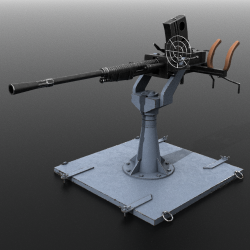
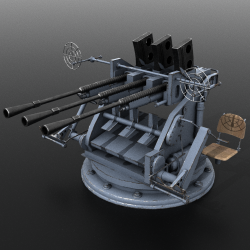
• Mountings: The gun was most commonly deployed in electrically powered twin mounts. These mounts featured fast tracking capabilities, elevating and training at 16 degrees per second, which allowed crews to follow active aircraft effectively. A single-barrel variant (Type 88) was also designed for use on submarines.
• Crew Optimization: To keep the sustained rate of fire high, Japanese engineers integrated a spring-powered rammer to automatically chamber shells. Crucially, the mount featured an automatically elevating platform for the loaders. As the guns tilted upward, the platform rose with them, ensuring the loading crew remained at the optimal height to feed the heavy fixed ammunition into the breech.
• Widespread Use: The Type 89 was universally fitted across the fleet. It escorted legendary ships like the Yamato (which carried twenty-four guns in twelve twin mounts), as well as carriers like Akagi and Shōkaku, and later-war destroyer classes like the Matsu.
Performance & Combat Reality
While highly reliable and responsive, the Type 89 suffered from a relatively low muzzle velocity compared to Allied counterparts (such as the American 5"/38 caliber gun at 2,600 fps). This lower velocity restricted its effective hitting range and reduced the window of time crews had to track and destroy increasingly fast Allied aircraft later in the war. Though the IJN developed the highly advanced 100 mm Type 98 naval gun as a superior high-velocity replacement, production limitations meant the Type 89 remained the most prevalent heavy fleet defense weapon until Japan's surrender in 1945.
Additional Information
The model was created based on blueprints, photos and historical documentation. It was created with precision in detail and in real units of measurement to be a faithful digital reproduction of the original. The object has been modeled in Lightwave and finished and texturized in 3DCoat.
LIGHTWAVE - The model comes with a simple Lightwave 2018 setup scene to animate pitch and heading rotation. UV mapped and original LW material included.
OBJ and FBX - model with UV maps. You may need to reassign textures when open the Obj file with different software.
BLENDER - UV model with uv material assigned.
The object has one UV map with color, normal, roughness, metalness and specular textures