HISTORICAL 3D MODELS · DIGITAL DOWNLOADS
CARLO CESTRADIGITAL PRODUCTIONS
Home / CGI Models / 25mm TYPE96
CGI / Digital 3D Model

25mm TYPE96

Choose the version and license that best fits your project.

Available versions & licenses

Choose a product version
Selected version$49.00USD
Included download files

File names only. Secure downloads become available after purchase.

License terms for selected version

Read the license conditions before purchasing. PDFs open in a new tab.

Digital products. Digital products only. Review the selected version and its license before purchase.

Description

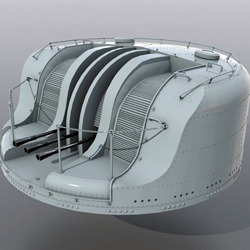
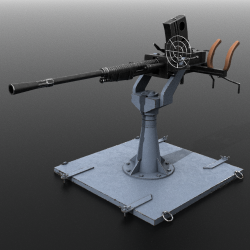
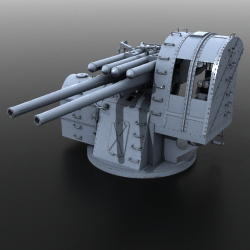
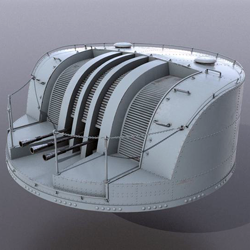
The Type 96 25mm gun was an automatic cannon used by the Imperial Japanese Navy during World War II. It was primarily used as an anti-aircraft gun in fixed mounts (e.g. battleship Yamato).

Technical Specifications

FormatLightwave 2018.x, OBJ, FBX, Blender 2.79
Compatibility3ds Max, Blender, Cinema4D, Houdini, Lightwave, Maya, Unity, Unreal Engine, Other
RiggedLightwave
GeometryPolygon mesh
Polygons Number22k
TexturesPBR
UV MappingYes

Historical Background

The Japanese Type 96 25mm Triple Gun Mount was the standard medium anti-aircraft weapon used by the Imperial Japanese Navy (IJN) during World War II. Originally derived from a French Hotchkiss design adopted in 1936, the triple-mount variant entered service in 1941 to bolster the fleet's defense against increasingly dangerous Allied aircraft. It was deployed heavily across nearly every major combat ship—with battleships like the Haruna carrying up to 118 mounts by 1945—as well as on land for airfield and base defense.

Technical Specifications
• Weapon Type: Automatic anti-aircraft cannon (Dual-purpose)
• Configuration: Three gas-operated, air-cooled gun barrels sharing a single heavy base plate
• Total Weight: Approximately 3,960 to 3,970 lbs (1,800 kg)
• Rate of Fire: 200–260 rounds per minute (cyclic) per barrel; standard setting was 220 rpm
• Muzzle Feed: Individual 15-round vertically loaded box magazines for each gun
• Range: Effective range of roughly 3,000 meters (Maximum ceiling: 7,500 meters)
• Elevation Limits: -10° to +85°

Crew Operations
A manually operated triple mount required a massive nine-man crew to function effectively:
• 1 Pointer (Left Gunner): Controlled the elevation gear manually using a crank, tracking targets via an iron ring sight, and fired the guns using foot pedals.
• 1 Trainer (Right Gunner): Controlled the traverse (azimuth) by manually turning a handwheel.
• 1 Sight Setter: Adjusted target data calculations.
• 6 Loaders: Working in pairs (2 per barrel) to constantly swap out the small 15-round magazines during active firing.

Performance & Combat Limitations
While highly reliable mechanically and widely utilized, the Type 96 triple mount is historically regarded as underwhelming and vastly inferior compared to Allied counterparts like the Bofors 40mm or Oerlikon 20mm systems. Its fatal flaws stemmed from a few key design parameters:
• The Magazine System: Because it relied on tiny 15-round box magazines rather than continuous belt feeds or large clips, the practical rate of fire dropped to just about 110 rpm due to constant reload delays.
• Slow Tracking Speeds: Manually cranking the heavy 1.8-ton mount limited elevation changes to 9° per second and traversal to 13° per second. This made it incredibly difficult for crews to track fast-moving, late-war Allied dive bombers and fighters.
• Low Destructive Power: The 25mm round lacked the explosive punch to bring down ruggedly built American aircraft quickly unless scoring a direct hit on a critical component.

Additional Information

The model was created based on blueprints, photos and historical documentation. It was created with precision in detail and in real units of measurement to be a faithful digital reproduction of the original. The object has been modeled in Lightwave and finished and texturized in 3DCoat.
LIGHTWAVE - The model comes with a simple Lightwave 2018 setup scene to animate pitch and heading rotation. UV mapped and original LW material included.
OBJ and FBX - model with UV maps. You may need to reassign textures when open the Obj file with different software.
BLENDER - UV model with uv material assigned.
The object has one UV map with color, normal, roughness, metalness and specular textures
Discover more models

You may also like

View collection →