HISTORICAL 3D MODELS · DIGITAL DOWNLOADS
CARLO CESTRADIGITAL PRODUCTIONS
Home / CGI Models / Type96 AA gun 1941
CGI / Digital 3D Model

Type96 AA gun 1941

Choose the version and license that best fits your project.

Available versions & licenses

Choose a product version
Selected version$24.99USD
Included download files

File names only. Secure downloads become available after purchase.

License terms for selected version

Read the license conditions before purchasing. PDFs open in a new tab.

Digital products. Digital products only. Review the selected version and its license before purchase.

Description

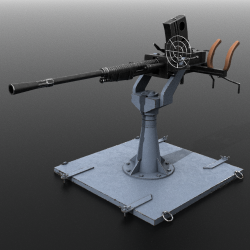
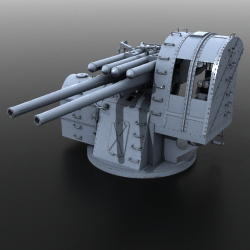
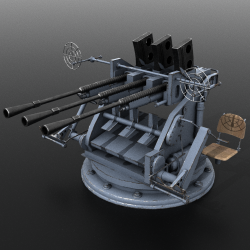
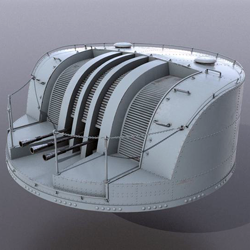
Type 96 gun was an automatic cannon used by the Imperial Japanese Navy during World War II. It was primarily used as an anti-aircraft gun in fixed mounts (e.g. battleship Yamato).

Technical Specifications

FormatLightwave 2018, OBJ, FBX, Blender 2.8
Compatibility3ds Max, Blender, Cinema4D, Houdini, Lightwave, Maya, Unity, Unreal Engine, Other
RiggedNo
GeometryPolygon mesh
Polygons Number43k
TexturesPBR
UV MappingYes

Historical Background

The Japanese Type 96 25 mm AT/AA gun (九六式二十五粍高角機銃) was the standard medium anti-aircraft weapon used by the Imperial Japanese Navy during World War II. Originally designed in 1935 as a locally built variant of the French Hotchkiss 25 mm autocannon, 1941 marked the critical introduction of the triple-barrel configuration.

Key Weapon Specifications (1941 Triple Mount)
Configuration: Triple-barrel powered or manual mount
Total Weight: 1,800 kg (approx. 3,960 lbs)
Barrel Length: 1.5 meters (L/60)
Ammunition: 25×163mm rimless rounds
Feed System: 15-round detachable box magazines
Standard Rate of Fire: 220 rounds per minute (per barrel, cyclic)
Crew Required: 9 men for the triple mount

The Significance of 1941
Prior to 1941, the weapon was primarily deployed in twin-barrel configurations. As the threat of faster, heavily armored Allied aircraft loomed ahead of the Pacific War, the Japanese Navy introduced the triple mount to maximize the volume of fire. These triple mounts were bolted onto virtually every major warship in the fleet, including the Yamato-class battleships, carriers, and cruisers.

Operational Strengths & Critical Weaknesses
While Japanese crews considered the Type 96 to be highly reliable and structurally robust, it suffered from severe tactical limitations when compared to Allied equivalents like the 40 mm Bofors:
• The Magazine Bottleneck: Because it relied on small, 15-round magazines inserted into the top of each breech, the gun required constant pauses to reload. This cut its practical, sustained rate of fire in half.
• Severe Vibration: Firing three barrels simultaneously caused excessive mount vibration, which heavily degraded target tracking and overall accuracy.
• Limited Effective Range: The Type 96 was only lethal within 1,000 meters. By the later stages of the war, Allied planes could often fire rockets or drop ordnance outside its effective envelope, rendering it highly underwhelming.

Additional Information

The model was created based on blueprints, photos and historical documentation. It was created with precision in detail and in real units of measurement to be a faithful digital reproduction of the original. The object has been modeled in Lightwave and finished and texturized in 3DCoat.
Some geometry (e.g. the chains segments) needs to be subdivided for close views.
Rivets are separated into a layer to use for different level of detail. The objects has 43711 polygons in total and 21337 polygons without rivets layer
The object has one UV map with color, normal, roughness, metalness and specular textures
Discover more models

You may also like

View collection →