HISTORICAL 3D MODELS · DIGITAL DOWNLOADS
CARLO CESTRADIGITAL PRODUCTIONS
Home / CGI Models / Japanese Type 96_25mm AT AA gun
CGI / Digital 3D Model

Japanese Type 96_25mm AT AA gun

Choose the version and license that best fits your project.

Available versions & licenses

Choose a product version
Selected version$39.00USD
Included download files

File names only. Secure downloads become available after purchase.

License terms for selected version

Read the license conditions before purchasing. PDFs open in a new tab.

Digital products. Digital products only. Review the selected version and its license before purchase.

Description

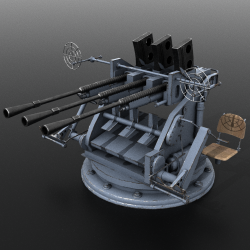
The Type 96 25mm AT/AA gun was an automatic cannon utilized extensively by the Imperial Japanese Navy (IJN) during World War II. Based on a 1935 French Hotchkiss design, it served as Japan’s primary light-and-medium anti-aircraft weapon. While multi-barrel variations (twin and triple mounts) were introduced first, the free-swinging single mount configuration was specifically developed later in 1943. This version became the mainstay anti-aircraft defense for naval vessels, submarines, and land installations toward the end of the Pacific War.

Technical Specifications

FormatLightwave 2018, OBJ, FBX, Blender 2.79
Compatibility3ds Max, Blender, Cinema4D, Houdini, Lightwave, Maya, Unity, Unreal Engine, Other
RiggedLightwave
GeometryPolygon mesh
Polygons Number20k
TexturesPBR
UV MappingYes

Historical Background

Technical Specifications
The single-barrel mount system was significantly lighter and offered different operational mechanics than its multi-barrel counterparts:
Type: Dual-purpose Anti-Aircraft / Anti-Tank Autocannon
Mass (Single Barrel): 785 kg (1,731 lbs) total mount system; gun body alone is ~115 kg
Barrel Length: 1.5 meters (4 ft 11 in) L/60
Shell Dimensions: 25 × 163 mm
Ammunition Feed: 15-round detachable box magazine
Rate of Fire: 200–260 rpm cyclic (Effective practical rate: 110–120 rpm due to magazine swaps)
Muzzle Velocity: 2,953 feet per second (900 m/s)
Effective Ceiling: 9,843 feet (approx. 3,000 meters)
Crew Complement: 3 personnel for the single mount (compared to 7 or 9 for twin/triple mounts)

Operational Performance & Flaws
Though the Imperial Japanese Navy regarded the Type 96 as a highly reliable piece of machinery, post-war evaluations concluded it was an underwhelming and mediocre weapon compared to Allied alternatives like the 20mm Oerlikon or 40mm Bofors.
• Magazine Restraints: The small 15-round box magazine required constant manual swapping. This dropped its theoretical rate of fire by more than half and interrupted tracking.
• Sluggish Adjustments: The manual hand-cranked traversal and elevation tracking systems were far too slow to effectively lock onto high-speed late-war Allied aircraft.
• Sight Limitations: The optical sights equipped on most mounts were inadequate for dealing with modern dive-bombers and fast torpedo-bombers.
• Low Destructive Power: The 25mm projectile lacked the fragmentation power or explosive payload necessary to reliably down armored aircraft with a single hit. It required a high concentration of sustained hits, which the slow reloading mechanism prevented.

Additional Information

The model was created based on blueprints, photos and historical documentation. It was created with precision in detail and in real units of measurement to be a faithful digital reproduction of the original. The object has been modeled in Lightwave and finished and texturized in 3DCoat.
LIGHTWAVE - The model comes with a simple Lightwave 2018 setup scene to animate pitch and heading rotation. UV mapped and original LW material included
OBJ and FBX - model with UV maps. You may need to reassign textures when open the Obj file with different software.
BLENDER - UV model with uv material assigned.
The object has one UV map with color, normal, roughness, metalness and specular textures
Discover more models

You may also like

View collection →